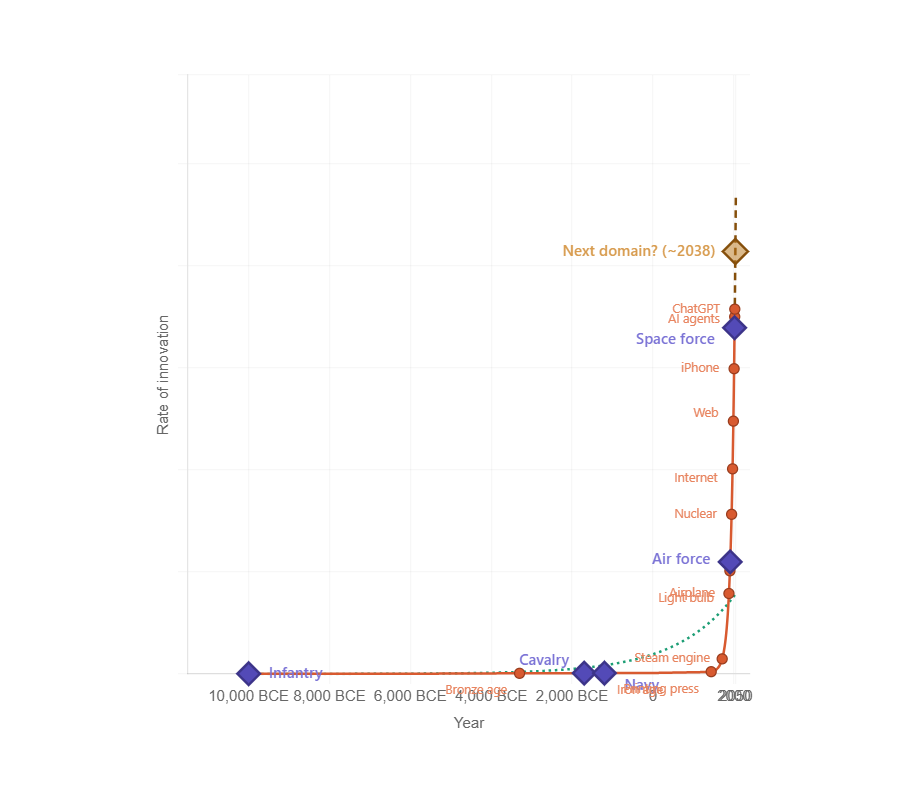
The shape this graph traces has a name. Mathematically, it's an exponential curve — y = a·e^(bx) — and the line of best fit confirms it with an R² in the high 0.9s. Informally, it's the "hockey stick" curve. Ray Kurzweil calls it the Law of Accelerating Returns. Historians call it the Great Acceleration. Whatever you call it, the shape is the same: flat for thousands of years, then a near-vertical spike in the last century.
The shape itself isn't the interesting part. Exponential curves all look identical when you zoom out far enough. What's interesting is that two seemingly different things — warfare domains and technology milestones — plot onto the same curve with that high an R². That means warfare and tech aren't two trends that happen to correlate. They're the same trend. Every new domain emerges as a direct function of what the underlying tech stack can support, and because tech is doubling on a fixed cadence, new warfare domains are doing the same.
You'll notice a 3,100-year gap between navy and air force on the chart. That's not missing data — that's the point. For three millennia, warfare was stuck in two domains because the enabling technology wasn't there. No flying machines, no satellites, no computers. Gunpowder, cannons, rifles, and tanks all came and went in that window, but none of them opened a new domain — they were weapons revolutions inside the land and sea domains we already had. A domain isn't just a new weapon. It's a new physical or informational medium where combat happens. Then the industrial revolution hit, and within 110 years we went from cavalry-and-galleons to fighter jets, ICBMs, and Stuxnet. The curve isn't smooth because history isn't smooth — it's flat until it isn't.
Because we've advanced exponentially in the technological domain, each new warfare domain comes faster and faster. Cavalry to navy took 500 years. Navy to air force took 3,100. Air force to space force took 108. The next gap is around 18 — putting Cyber Force formalization right around 2037–2038. It might be far out to guess, but the domain after that, around 2047, would likely be specialization in cognition and neural control.
You may think we already have parts of both of those. Stuxnet took out Iranian centrifuges in 2010 without firing a shot. The recent operation to capture Maduro reportedly used two pieces of hardware that read like science fiction — a high-powered microwave weapon exploiting the Frey effect to broadcast sounds directly into a target's skull, and an infrasonic pulse emitter that incapacitates entire formations through cavitation in soft tissue. A team of 20 operators walked through a force of hundreds because the hundreds were already on the ground vomiting and bleeding from their ears.
Or take Ghost Murmur — the quantum magnetometry system the CIA reportedly used in April 2026 to track a downed F-15E weapons system officer in Iran. It locks onto a single human heartbeat from 40 miles out, through solid rock, using nitrogen-vacancy defects in synthetic diamonds to read the electromagnetic field of cardiac muscle depolarization. No infrared. No satellite imagery. No radio signal from the target. Just the bioelectric ghost of a beating heart, picked out of a thousand square miles of desert noise by an AI trained to recognize one specific rhythm.
That capability didn't exist five years ago. It's deployed today. And it's a perfect snapshot of where the curve actually is right now — quantum sensing, AI signal processing, and directed energy all mature enough to put on a Blackhawk.
But here's the thing — for something to be a domain, it has to be widely used and fought over for control by multiple nations. Cyber capabilities have existed since the 90s. Cognitive warfare tech exists today. What's missing in both cases is the institutional formalization — the moment when enough major powers have stood up dedicated branches that the domain becomes its own contested arena, the way space did in 2019.
Cyber Command was elevated to a unified combatant command in 2018. That's the same step Space Command took before Space Force. Russia has its information operations forces. China has the Strategic Support Force, which folds cyber and space together. The institutional scaffolding is already being built. By the late 2030s, expect to see the U.S. stand up a full Cyber Force, with cognitive/neural following roughly a decade later.
Some futurists call the point where this curve goes near-vertical the "singularity" — the bend point past which prediction breaks down. They place it somewhere in the 2040s. That's uncomfortably close to where the next two warfare domains land on the chart.
The graph doesn't lie. The shape it traces — flat for 12,000 years, vertical now — means the next domain isn't a question of if, it's a question of who builds it first.
Discussion · 0
Comments are temporarily disabled.